SIP in 2026: Record SIP Investments — What It Really Means for Investors
SIP investing is having another record year in India. But a record SIP number does not automatically mean that every investor should invest more, switch funds, or chase the latest market trend.
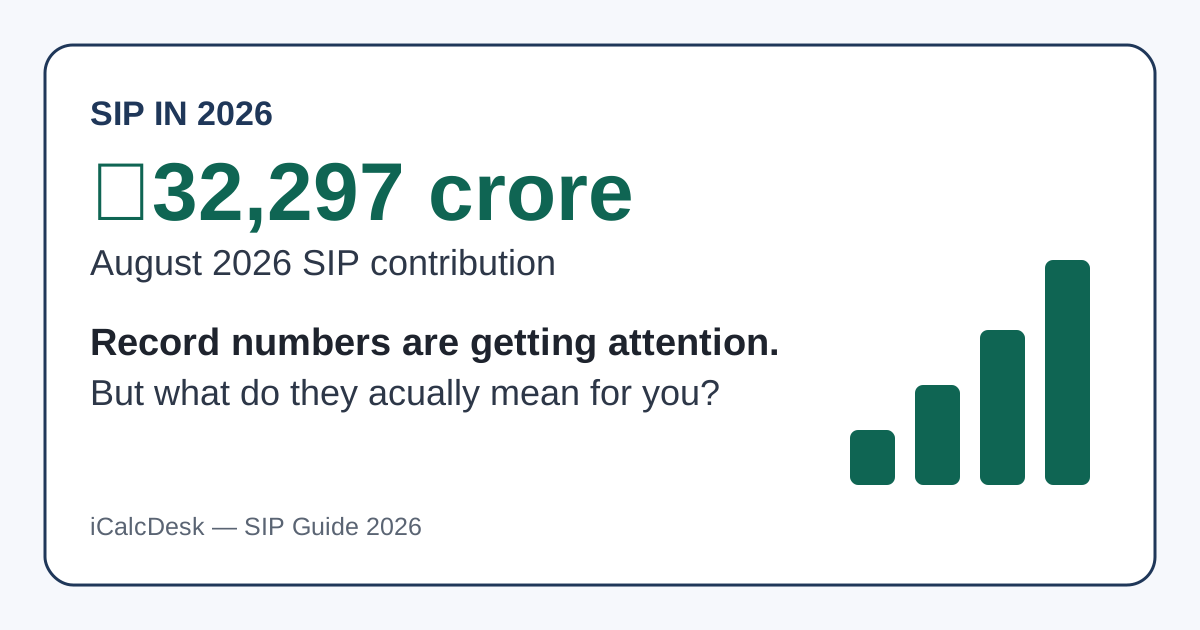
In August 2026, investors put ₹32,297 crore through SIPs, the highest monthly SIP contribution reported so far in FY 2026-27. The mutual fund industry's assets under management stood at about ₹87.08 lakh crore at the end of August 2026.
So what should an ordinary investor actually take away from these numbers?
That is the more useful question.
Record SIP flows show that systematic investing has become a major part of how Indians invest in mutual funds. They do not tell you which fund to buy, whether the market is cheap or expensive, or how much you personally should invest.
What happened to SIPs in 2026?
AMFI data shows how quickly monthly SIP contributions have grown during the current financial year:
| Month | SIP contribution |
|---|---|
| April 2026 | ₹31,115 crore |
| May 2026 | ₹30,954 crore |
| June 2026 | ₹31,781 crore |
| July 2026 | ₹31,961 crore |
| August 2026 | ₹32,297 crore |
August's ₹32,297 crore was higher than July's ₹31,961 crore. AMFI also reported about 10.02 crore contributing SIP accounts and about 10.75 crore outstanding SIP accounts at the end of August 2026.
The bigger story is not one record month. It is the consistency.
SIP contributions have remained above ₹30,000 crore in every month from April through August 2026.
Why are so many people using SIPs?
The appeal of a SIP is fairly simple: instead of waiting for the "perfect" market entry point, an investor commits a fixed amount at regular intervals.
That can make investing easier to stick with.
AMFI describes SIPs as a method of investing a fixed amount periodically and notes that regular investing can help investors maintain discipline and use rupee-cost averaging. It also cautions that rupee-cost averaging does not guarantee profits or protect against losses.
For many investors, the practical advantages are:
1. It turns investing into a habit
A monthly auto-debit can remove the need to make a fresh investing decision every month.
2. You do not need to predict the market
Your monthly investment buys units at the NAV available on that date. You therefore buy more units when prices are lower and fewer when prices are higher.
That does not eliminate market risk, but it can reduce the pressure to pick one "perfect" entry point.
3. It works naturally with monthly income
For someone who receives a salary every month, investing a fixed amount can be easier than waiting for a large lump sum.
4. Time can do more work than excitement
The real advantage of a long-term SIP is not finding the hottest fund. It is giving your investment enough time for compounding to work.
But here is the important part: a record SIP is not a buy signal
This is where many headlines can become misleading.
If SIP contributions reach a record, it means investors collectively invested a record amount through SIPs during that month.
It does not tell us:
- whether the stock market is undervalued;
- whether equity funds will deliver high returns next year;
- whether small-cap funds are suitable for you;
- whether your current SIP amount is too low or too high;
- or whether you should change your existing portfolio.
Think of the ₹32,297 crore figure as an investor-behaviour statistic, not an investment recommendation.
A record SIP number tells you what investors are doing. It does not tell you what you should do.
What about the ₹87 lakh crore mutual fund industry?
AMFI reported that the industry's AUM stood at ₹87.08 lakh crore as of August 31, 2026, while average AUM for August was ₹88.31 lakh crore.
The distinction matters.
AUM is not the same thing as money newly invested during the month. A fund's AUM can change because of fresh investments, redemptions, and changes in the market value of securities held by mutual funds.
So do not compare the ₹87.08 lakh crore AUM number directly with the ₹32,297 crore monthly SIP contribution and conclude that one caused the other.
They measure different things.
Should you increase your SIP because SIP numbers are at a record?
Not automatically.
A better way to decide is to start with your own numbers.
Ask yourself:
- How much can I invest every month without creating cash-flow stress?
- Do I have an emergency fund?
- Are my high-cost debts under control?
- What is the goal for this money?
- When will I need the money?
- How much market volatility can I realistically tolerate?
- Does my current asset allocation match that goal?
If your income has increased and your financial situation has improved, increasing a SIP may make sense as part of your own plan. But the reason should be your goal, cash flow and time horizon, not simply a record industry statistic.
The small-cap temptation
When investors see strong market returns or hear about high SIP flows, it is easy to jump towards funds that have recently performed well.
That can be especially tempting with small-cap and mid-cap funds.
But a SIP is only a method of investing. The risk comes from the underlying investment.
A ₹5,000 SIP in a diversified equity fund and a ₹5,000 SIP in a much more volatile fund are both "SIPs", but they are not the same investment.
Before choosing a fund, look beyond its recent return:
- What does the fund invest in?
- How concentrated is the portfolio?
- What level of volatility can you tolerate?
- How long can you stay invested?
- Does it overlap heavily with funds you already own?
- Does it fit the purpose of the money?
Do not let the word "SIP" create a false sense that the investment itself is low-risk.
What happens when the market falls?
This is one of the most important things to understand before starting an equity SIP.
Suppose your monthly SIP is ₹5,000.
If the NAV is ₹50, you buy 100 units.
If the NAV later falls to ₹40, the same ₹5,000 buys 125 units.
That is the basic arithmetic behind rupee-cost averaging.
But there is an important limitation: lower prices do not guarantee that an investment will recover. AMFI specifically notes that rupee-cost averaging does not assure profit or protect against losses in declining markets.
This is why fund selection, diversification and time horizon still matter.
A simple SIP checklist for 2026
Before starting or increasing a SIP, use this five-minute checklist:
If you are a beginner
- Start with an amount you can sustain.
- Understand what the underlying mutual fund invests in.
- Keep an emergency reserve separate from long-term investments.
- Do not choose a fund only because it recently delivered a high return.
- Learn the difference between equity, debt and hybrid funds.
If you already have SIPs
- Review your goals and time horizon.
- Check whether multiple funds are doing essentially the same job.
- Review your asset allocation rather than only looking at returns.
- Avoid stopping an investment purely because the market has corrected.
- Increase your SIP when your income and goals justify it, not because a headline says SIPs are booming.
Use the SIP Calculator before changing your investment
Instead of asking, "Everyone is investing ₹10,000 a month. Should I also?"
Ask:
"How much do I actually need to invest to reach my goal?"
Use the iCalcDesk SIP Calculator to test different monthly amounts, investment periods and assumed returns.
Try three scenarios rather than relying on one return assumption:
- Lower-return scenario: 8%
- Middle scenario: 10–12%
- Higher-return scenario: 14%
These are planning assumptions, not guaranteed returns.
For example, you can compare a ₹5,000 monthly SIP with ₹7,500 and ₹10,000 over the same period. The difference can help you decide whether increasing your SIP is actually necessary for your target.
SIP vs. lump sum: which one should you use?
There is no universal answer.
A SIP is convenient for regular income because it spreads purchases over time.
A lump-sum investment may be relevant when you already have a large amount available and have a suitable investment plan for it.
The important point is that SIP and lump sum describe how money is invested; they do not tell you which asset or mutual fund is appropriate.
If you are comparing the two approaches, read our SIP vs Lumpsum guide.
The biggest SIP mistakes to avoid
Stopping every time the market falls
A market correction can feel uncomfortable, but stopping an investment based only on short-term market movement can break the discipline that made the SIP useful in the first place.
Chasing the previous year's winner
Past performance does not guarantee future returns. A fund that performed strongly recently can still underperform later.
Increasing the SIP without checking your cash flow
A larger SIP is not automatically better if it leaves you short of money for emergencies or essential expenses.
Owning too many funds
Five or ten SIPs do not automatically mean better diversification. Several funds may own many of the same companies.
Treating SIP as a risk-free product
SIP is a process, not a guarantee. If the underlying mutual fund is market-linked, the investment value can rise or fall.
What the 2026 SIP record really tells us
The most useful conclusion from the August numbers is simple:
SIP investing has become a large and persistent part of India's mutual fund ecosystem.
AMFI's August data shows ₹32,297 crore of SIP contributions for the month and ₹18.62 lakh crore of SIP AUM.
That is meaningful as an industry trend.
But your personal investing decision should still come back to the basics:
Goal → Time horizon → Risk → Asset allocation → Investment amount → Review
Not:
Headline → Hype → Buy
You do not need to beat everyone else's SIP. You need an investment plan that you can understand, afford and stick with for the period your goal requires.
Frequently Asked Questions
Is SIP a good investment in 2026?
SIP is a method of investing, not a separate investment product. Whether it is appropriate depends on the mutual fund selected, your goal, time horizon, risk tolerance and financial situation.
What was the SIP contribution in August 2026?
AMFI reported ₹32,297 crore of SIP contributions in August 2026. This was higher than the ₹31,961 crore recorded in July 2026.
Does a record SIP contribution mean the stock market will rise?
No. SIP contribution data measures how much investors contributed through SIPs. It does not predict future market returns.
Should I stop my SIP when the market falls?
A market fall by itself is not a sufficient reason to stop a SIP. First consider your goal, time horizon, risk tolerance and the suitability of the underlying fund. Market-linked investments can lose value, and past performance does not guarantee future results.
Is SIP risk-free?
No. SIP itself is only an investment method. The risk depends largely on the underlying mutual fund and its investments.
How much should I invest in a SIP every month?
There is no single correct amount. Start with your financial goal, time horizon and affordable monthly surplus. Use a SIP calculator to test how different monthly amounts and time periods affect the projected corpus.
Related Guides
Sources
Disclaimer: This article is for general educational purposes only and does not constitute investment advice. Mutual fund investments are subject to market risks. Read all scheme-related documents carefully before investing.
Comments
Responses 0
Loading comments...